The academic landscape of 2026 bears little resemblance to the library-stack marathons of a decade ago. Today, the “digital-first” student doesn’t just search for information; they interact with it. As generative AI matures from a novelty into a foundational infrastructure, college research has shifted from a process of manual data retrieval to one of high-level synthesis and cognitive partnership.
For students balancing complex workloads, the pressure to maintain quality while navigating these new tools can be overwhelming. Many choose to myassignmenthelp services to bridge the gap between AI-generated drafts and high-distinction submissions. When you decide to do my project for me, you aren’t just looking for an easy out; you are seeking a strategic partner to help navigate the ethical and structural complexities of modern academia.
The 2026 Shift: From Search Engines to Answer Engines
In 2026, the traditional search bar has been largely replaced by Agentic AI—systems capable of executing multi-step research tasks autonomously. According to the HEPI Student Generative AI Survey 2026, a staggering 95% of students now report using AI in at least one way during their research process.
The evolution is characterized by three primary shifts:
- Semantic Synthesis over Keyword Matching: Tools like Perplexity Pro and Gemini 3 Flash no longer just list links; they synthesize consensus from peer-reviewed journals.
- The Rise of Personal Research Repositories: Platforms like NotebookLM allow students to upload 100+ PDFs (syllabi, JSTOR articles, and lecture notes) to create a private, hallucination-free knowledge base.
- Real-Time Data Analysis: Engineering and Finance students now use specialized models to run simulations and verify statistical trends in seconds—tasks that previously required weeks of manual coding in R or Python.
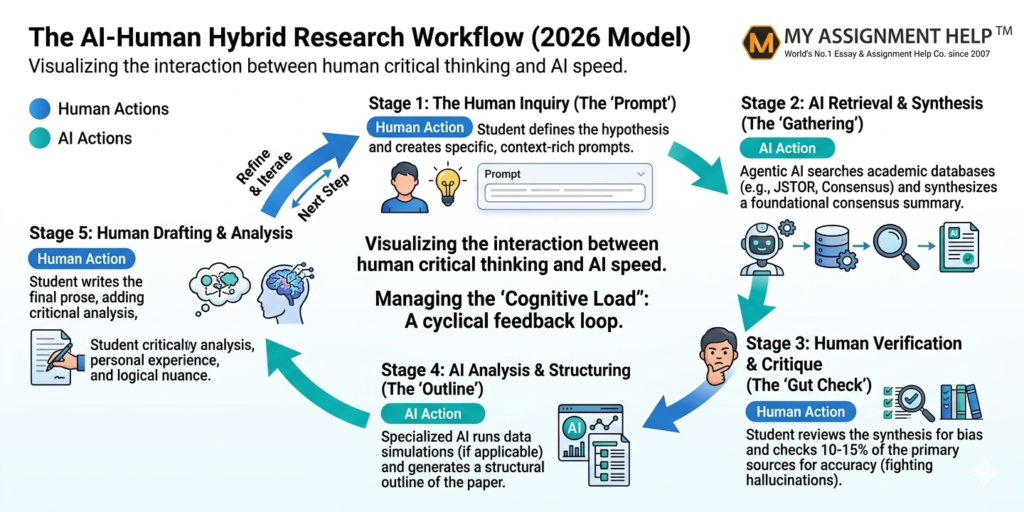
Managing the “Cognitive Load”: Visualizing the AI Research Workflow
The modern research cycle is no longer linear. It is a feedback loop between human intuition and machine efficiency. To understand how to balance these, consider the following structural breakdown:
Data-Driven Insights: Student Adoption Rates (2026)
| AI Utility Category | Adoption Rate (%) | Primary Tool Used |
| Literature Review | 88% | Consensus / SciSpace |
| Drafting & Outlining | 74% | Claude 4.5 / ChatGPT |
| Data Visualization | 41% | Canva AI / WolframAlpha |
| Citation Management | 92% | Citavi / Zotero AI |
Source: Master of Code – Generative AI Statistics 2026.
The Ethical Frontier: Integrity in the Age of Automation
While the efficiency gains are undeniable, the 2026 academic year has seen a “cracking down” on low-effort AI usage. Universities have pivoted from banning AI to mandating AI Transparency Reports. Students must now document how they used AI—whether for brainstorming, structural editing, or data analysis.
This is where the distinction between “AI-generated” and “Expert-refined” becomes critical. Using AI for a personal essay topics brainstorm is helpful, but the soul of the essay—the lived experience—must remain human. Google’s E-E-A-T (Experience, Expertise, Authoritativeness, and Trustworthiness) guidelines now apply heavily to academic content; if a paper lacks “Experience” (the human element), it fails both the professor’s rubric and the algorithm’s quality check.
Key Takeaways for 2026 Researchers
- Prioritize Verification: Always cross-reference AI-generated citations. Despite improvements, “hallucinations” still occur in 15% of complex technical queries.
- Focus on Prompt Engineering: The quality of your research depends on your ability to provide specific, context-rich prompts.
- Maintain Your Voice: Use AI for the “skeleton” of your work, but ensure the “muscle” (the critical analysis) is yours.
- Leverage Hybrid Services: For high-stakes projects, human-led academic services provide the necessary E-E-A-T signals that AI alone cannot replicate.
Frequently Asked Questions (FAQ)
Q1: Is using AI for research considered plagiarism in 2026?
Not necessarily. Most US and UK universities distinguish between “AI-assisted” (permitted with disclosure) and “AI-generated” (often prohibited). Always check your specific institutional policy on AI transparency.
Q2: Which AI tool is best for peer-reviewed sources?
As of 2026, Consensus and Perplexity AI (Pro version) are the leaders, as they specifically index academic databases and provide direct citations to published papers.
Q3: How do I ensure my paper passes AI detectors?
The best way is to write the final draft yourself. Use AI for research, data sorting, and outlining, but ensure the actual prose is your own. This ensures your unique “Experience” and “Expertise” are evident.
About the Author
Alex Henderson is a Senior Academic Strategist at MyAssignmentHelp. With over 8 years of experience in digital education and SEO strategy, Alex specializes in helping students navigate the intersection of emerging technology and academic integrity. He holds a Master’s in Educational Technology and has published extensively on the impact of AI on US higher education.
References
- HEPI Student Generative AI Survey 2026.
- Lumivero: Best AI Tools for Academic Research in 2026.
- Master of Code: Generative AI Statistics and Trends (January 2026).
- Google Search Quality Rater Guidelines: E-E-A-T Evolution 2026.